Blogs posted from this ecoregion: No blogs have yet been posted from this ecoregion.
The map shows the entire ecoregion, in light blue, very elongated north to south following the axis of the Andes, extending from near Salta, Argentina to well south of Santiago, Chile. In the vicinity of Santiago, in February 2026 I did not not note any remnants of Valdividian Temperate Forests east of Santiago so for convenience, considered that this ecoregion began immediately west of the capital.
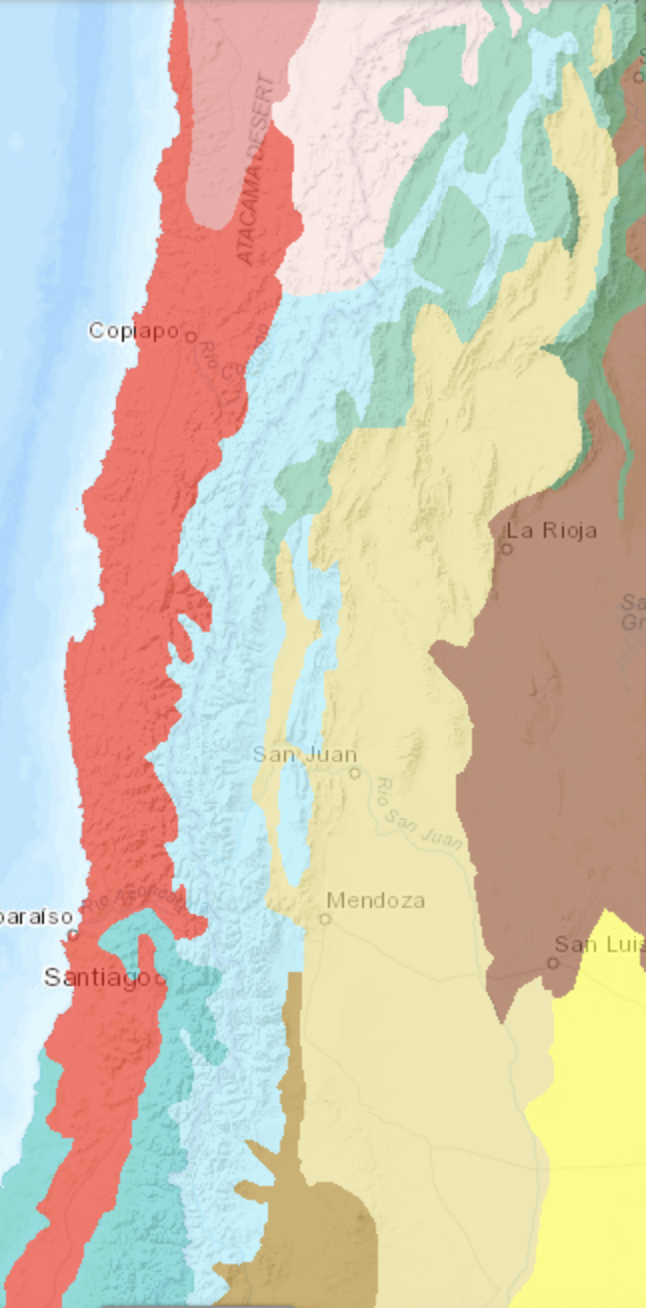
Adjacent ecoregions include the following: i-iii) at the northern extremity of the ecoregion, it interdigitates with three high Andean ecoregions (Central Andean Puna, NT1002; Central Andean Dry Puna, NT1001; and the High Monte, NT1010); iv) to the southeast, south of about Mendoza in Argentina is the Low Monte (NT0802), bordering the ecoregion for a short distance; v) to the east, south of about the latitude of Santiago, is the Patagonian Steppe (NT0805); vi) to the southwest we find the Valdivian Temperate Forests (NT0404); and vii) to the northwest is the Chilean Matorral (NT1201).
Description of the Ecoregion
A complete description of this WWF ecoregion can be found at https://en.wikipedia.org/wiki/Southern_Andean_steppe. It is a is a montane grasslands and shrublands ecoregion occurring along the border of Chile and Argentina in the high elevations of the southern Andes mountain range.
The flora of this ecoregion is adapted to its cold, dry, and windy climate. Many of the plant genera have evolved endemic species.
The plants on the western side of this ecoregion can be divided into three zones based on their growth forms and elevation. In the lower elevations, 2,000 to 2,700 metres (6,600 to 8,900 ft), grow large shrubs such as Chuquiraga oppositifolia and Nassauvia axillaris. In intermediate elevations, 2,700 to 3,300 metres (8,900 to 10,800 ft), grow small shrubs, tussock grasses, and cushions. These include Azorella madreporica, Laretia acaulis, and Stipa spp. In the highest elevations, extending to 3,900 metres (12,800 ft), grow small forbs, rosettes, and grasses such as Nassauvia lagascae, Oxalis erythrorhiza, Nassauvia pinnigera and Moschopsis leyboldii.[2]
The plants on the eastern side do not grow in distinct zones.
Birds of the Ecoregion
The fauna is similar to that of the Central Andean dry puna and the Patagonian steppe. There are no bird species endemic to this specific ecoregion.
Resources for the Ecoregion Birder
Known resources are the usual range of bird field guides and resources on birds of the Andes. No known publications are specific to this ecoregion.
DJG: xx spp. (July 11, 2015)