Welcome to this site on ecoregion birding. It is also a blog where I write about various thoughts related to birding and ecoregions or more generally about conservation, and where I try to share my passion for the fascinating little stories of nature, and the links that bind everything together.
About Ecoregions
The World Wildlife Fund (WWF) defines an ecoregion as “a relatively large area of land or water that contains a geographically distinct assemblage of natural communities. These communities (1) share a large majority of their species, dynamics, and environmental conditions, and (2) function together effectively as a conservation unit at global and continental scales” (Ricketts et al., 1999: Terrestrial Ecoregions of North America: a Conservation Assessment).
We follow here the ecoregions as defined by WWF. Their first publication on this global classification system was the 1995 “A Conservation Assessment of the terrestrial ecoregions of Latin American and the Caribbean”. This was jointly published by the World Bank and WWF and I was a co-author.

In subsequent publications, WWF mapped and described what would eventually be a total of 867 global terrestrial ecoregions; Eric Dinerstein and David Olson were lead authors on these publications.
It was formerly possible on the WWF site to consult maps and descriptions of all the world’s ecoregions but in 2018, WWF inexplicably retired their Wildfinder site. Maps and descriptions of the world’s ecoregions can still be found at a number of sites (including this one, at least for the North American ecoregions). Another good source is Wikipedia which has a page for almost every ecoregion. A source for the maps, for all the world’s ecoregions, is Data Basin.
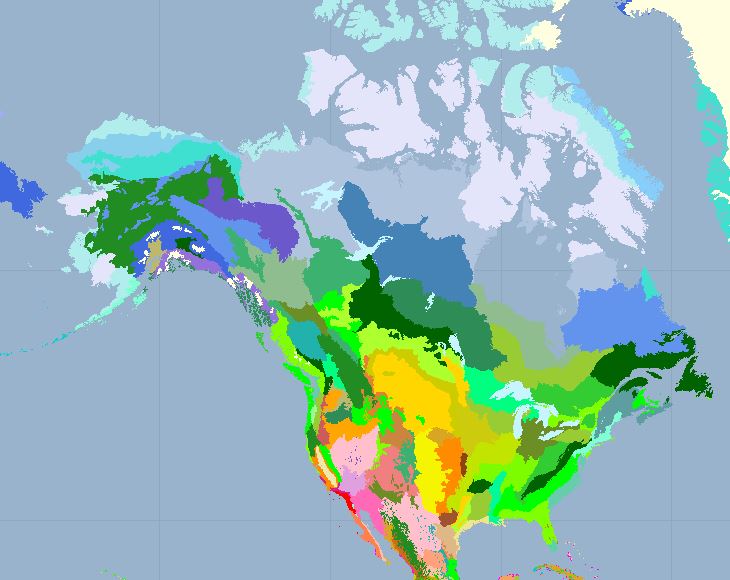
The ecoregion pages at my site, accessible from the broad habitat groupings in the menu, cover all 109 terrestrial ecoregions of North America. Each page includes a map, brief description, notes on the ecoregion’s avifauna, and a few resources for ecoregion birders. Note that many text elements are under construction (you are more than welcome to contribute!). A few ecoregions outside of North America can be found under a separate menu heading. The map below show the ecoregions of North America.
About Ecoregion Birding
Birders traditionally keep lists by regional district, county, state, province, or country, which are all units with little to no biological meaning or interest. Ecoregion birding means keeping bird lists by ecoregion, a human-defined area for sure, but one that is based on natural characteristics. For several decades, I have kept my bird lists by ecoregion. I may be the world’s only ecoregion birder (?), but I think its an approach that puts sense and biological reality into lists.
Over the last decade I put a great deal of effort into determining the “characteristic” bird species of each ecoregion in North America, that is, the list of species to be found reliably and annually in the mix of habitats that define each ecoregion, excluding vagrant species and those only peripherally present. I have archived this information for some 30 ecoregions but have now given up on this overly ambitious plan.
About me
Douglas J. Graham is a Canadian living in Kelowna, BC (formerly residing in Maryland, from 1992 to 2019). I am originally from Thunder Bay, ON (Western Great Lakes Forests Ecoregion). I am a retired biologist, formerly an Environmental Specialist at the World Bank in Washington, DC. My spouse is France Marcoux from Québec City, QC (Eastern Great Lakes Lowland Forests Ecoregion), with a great appreciation of nature and traveling.
I can be reached at douglasjgraham@me.com.
Here are some of my most recent observations from my latest passion: iNaturalist.


Amazing wonderful. Your lives have purpose, entertainment and adventure and learning – the study of birds and their ecoregions in NA can only be the tip of the iceberg in the fascination and wonder of the evolution of life on Earth. Thanks for your write-ups Doug and thanks for your pictures France.