Blogs posted from this ecoregion:
- Out of Africa in Morocco (January 2026)
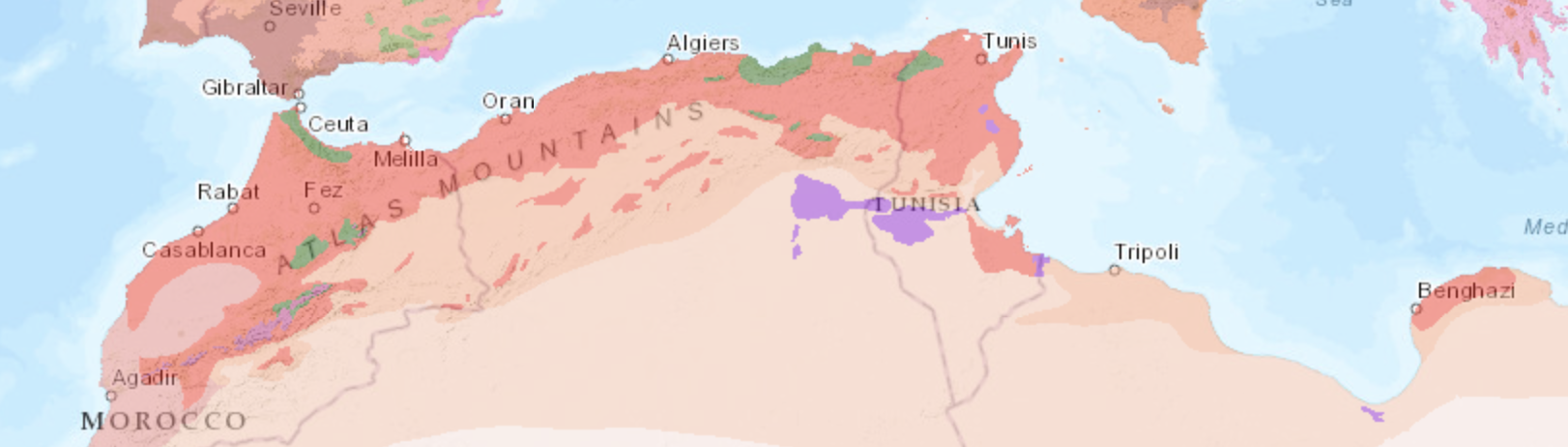
This ecoregion, darkish red on the map below, occupies the coastal plains, hills, and mountains along the Mediterranean coast of north Africa from Morocco in the west through Algeria and Tunisia. A disjunct area occurs near Benghazi in Libya. In Morocco, it extends inland to cover the lower slopes of the Middle Atlas and High Atlas ranges.
Adjacent ecoregions include the following, from the Strait of Gibraltar clockwise: i) the green patches of the Mediterranean Conifer and Mixed Forests (PA0513);the drier Mediterranean Dry Woodlands and Steppe (PA1213) to the south; iii) enclosed purplish patches of the Atlas Mountains, the Mediterranean High Atlas Juniper Steppe (PA1010); and iv) in its westernpost part, the enclosed Mediterranean Acacia-Argania Dry Woodlands and Succulent Thickets (PA1212).
Description of the Ecoregion
This description is adapted from the ecoregion’s Wikipedia page and from WWF. The natural vegetation of the area is forests, woodlands, and shrublands. The Wikipedia page provides details on five major plant communities: xeric pine forests and woodlands, Berber Thuya forests and woodlands, Cork Oak woodlands, Holm Oak and Kermes Oak forests and woodlands, and Wild Olive and Carob woodlands and maquis.
Birds of the Ecoregion
Wikipedia notes that: “The ecoregion has 120 native bird species. They include the raptors Golden Eagle (Aquila chrysaetos), Black-winged Kite (Elanus caeruleus), Short-toed Snake Eagle (Circaetus gallicus), Booted Eagle (Hieratus pennatus), and Lesser Kestrel (Falco naumanni). Subspecies of the Great Spotted Woodpecker (Dendrocopos major numidus) and Grey Shrike (Lanus meridionalis algeriensis) are endemic to the ecoregion and the adjacent Mediterranean conifer and mixed forests.
Resources for the Ecoregion Birder
No particular resources have yet been identified.
DJG: 0 spp. (April 2025)